

Hallow Realm is an asymmetrical arena-scale VR horror game pitting Ghosts against Ghost Hunters. That is a mouthful! Basically, all kills are instant and Ghosts must get close to Hunters to kill them by touching them. Ghosts can go invisible if they move slowly, and can fly indefinitely. Hunters have a long-range pistol with limited ammo, and a flashlight that flickers if an invisible Ghost is in its light cone. Hunters are working to collect a resource (“Realm Dust”) and deliver it to multiple objective locations (“Centrifuges”). If Hunters can meet the resource threshold within the time limit of the 12-minute round, Hunters win! Ghosts are doing everything they can to stop them.
My contributions to Hallow Realm include:
- All design of the 2 shipped maps—starting with 2D drawings over the floorplans of our buildings; moving then to playable blockouts in UE4; advancing to an abridged playtesting and revision phase; and concluding with full gameplay implementation and public release.
- Both of these maps adapt layout based on player count, anywhere from 2-16 players. In practice this amounts to various doors opening or obstacles hiding in order to expand the bounds of the map. Door placement and player-count “opening thresholds” were tweaked post-launch as I optimized both maps to have the perfect size and layout no matter the player count.
- A novel way to mirror opposing players’ digital X/Y positions that is currently patent pending that we implemented in order to enable necessary melee combat for players in the same arena space without inevitable physical player collision.
- Combat ability design & weapon behavior—ammo counts, ammo pickup placement, Realm Dust placement, Centrifuge placement, Ghost movement threshold for invisibility, etc.
- Objective-based game mode ruleset design and asset creation—Blueprint code for the Centrifuge and Realm Dust piles, 3D modeling of mode-specific assets in Maya (centrifuge, generator, and teleporter), and particle effect creation in UE4 Cascade for Realm Dust and Teleporter.
- Environment art for various areas—the basement area of our smaller map and roughly a third of the individual rooms in our larger map.
- Blueprint code and sound design for “trigger events” that are scattered around each map—these provide context clues for attentive players (nearby players—even invisible Ghosts—will trigger open lockers to slam shut, steam to spew from vents, sinks to run, chairs to topple, etc.)
Hallow Realm was released in October of 2019 after a condensed dev cycle of only 3 months for our team of then only 6 developers. It was released to coincide with Halloween season, but has remained a year-round MassVR staple. I served as the game & level designer, and helped where needed on environment art and tech art to meet the project deadline.
Level Design Process


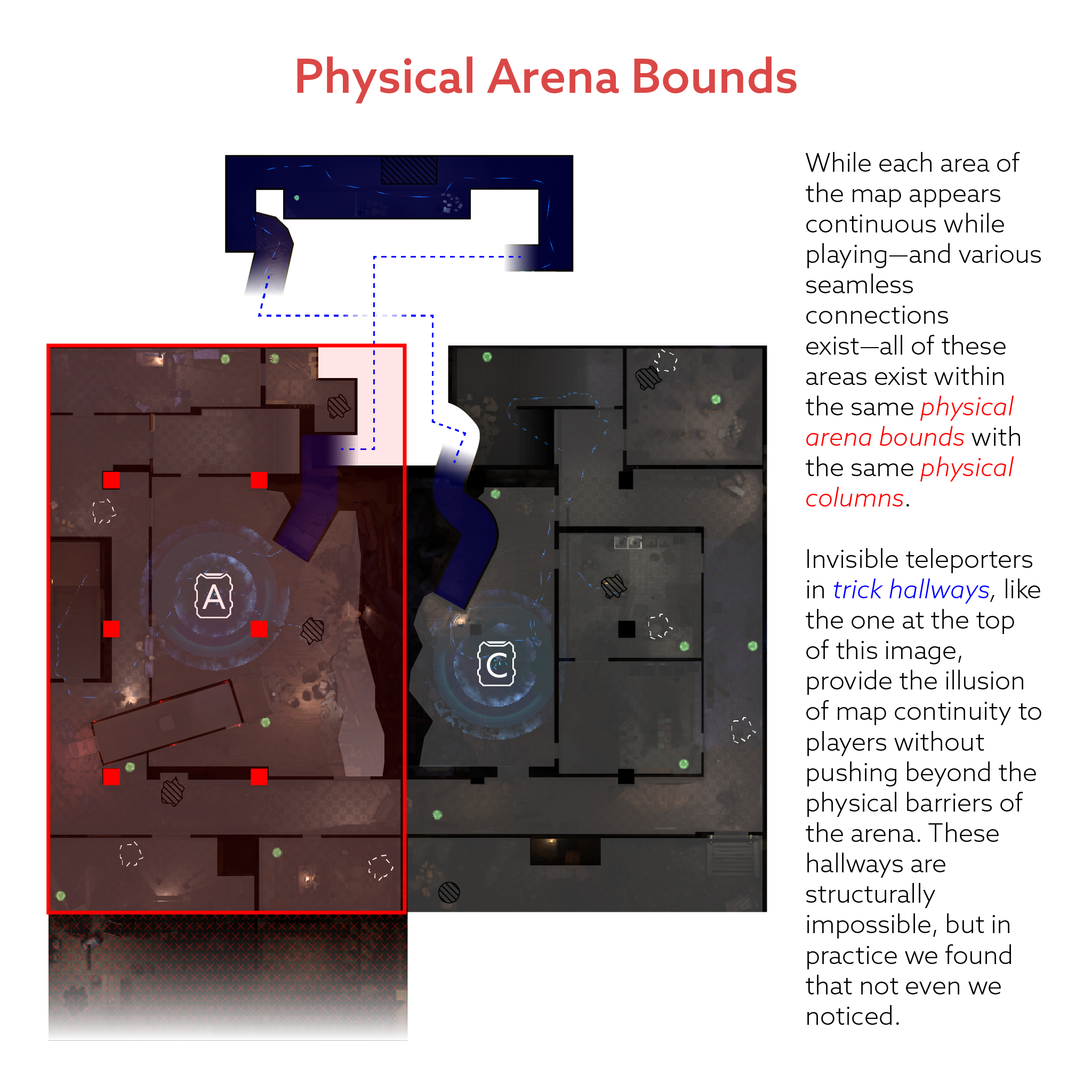
My arena-scale VR level design work always begins with a 2D sketch over the simplified floorplan of our facility. My main concerns from the start are arena bounds and column placement. But as my design process progresses I must also consider other existing paths, doors, walls, and obstacles I placed that may exist in the same physical place as others. This is because every area of the level is stacked on top of one another in physical space while seemingly continuous in digital space. If I place a doorway in one area of the level on grid tile G4, and place another doorway in a separate area of the map on G4 yet again I will have created a situation in which players in two distant areas of the level will meet in the real world to physically block each other from getting through their respective doorways without an awkward “no, you go first” dance. And so, I try to offset any and all main paths, doors, and obstacles from one another in each area of my levels (while still balancing my initial design intentions of course).
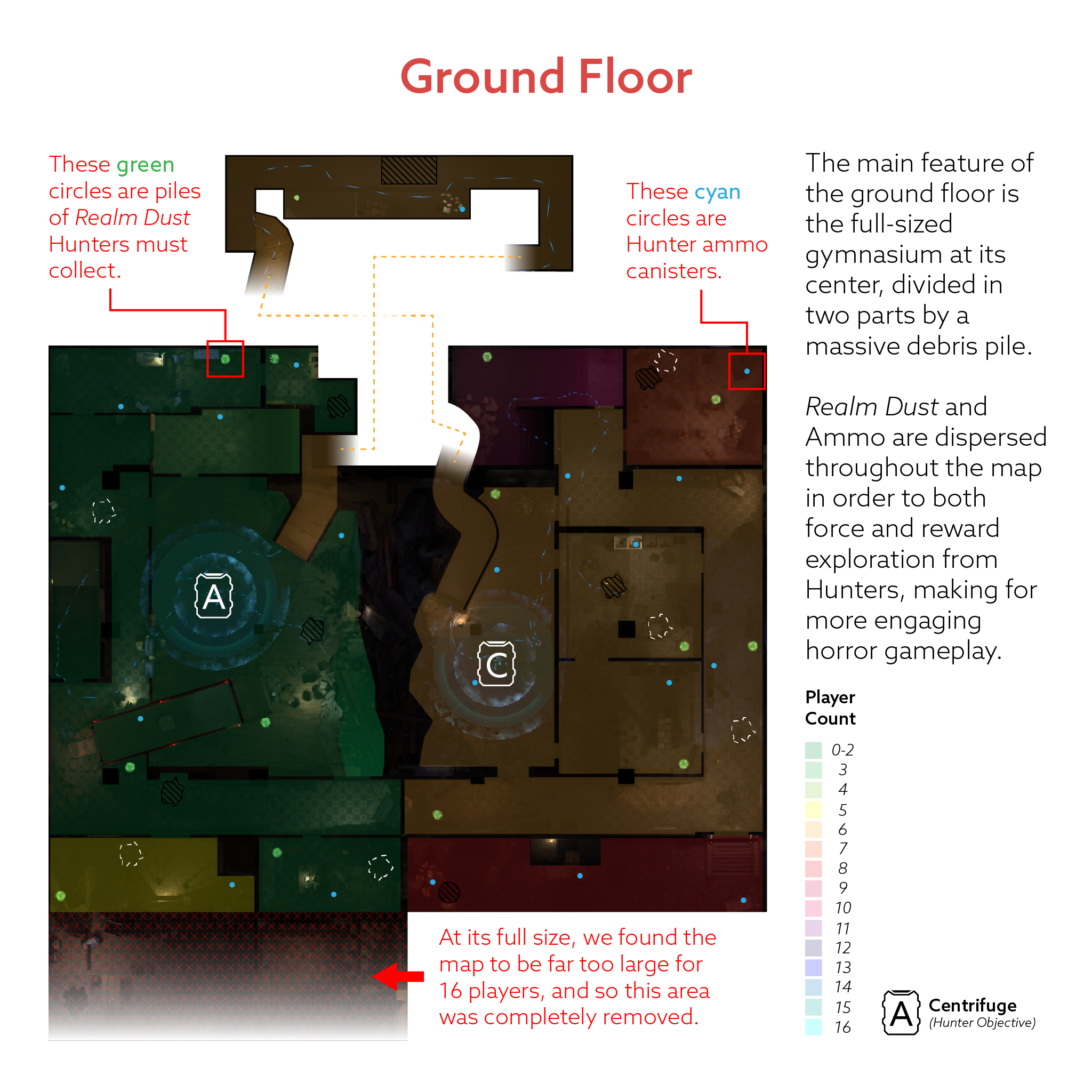
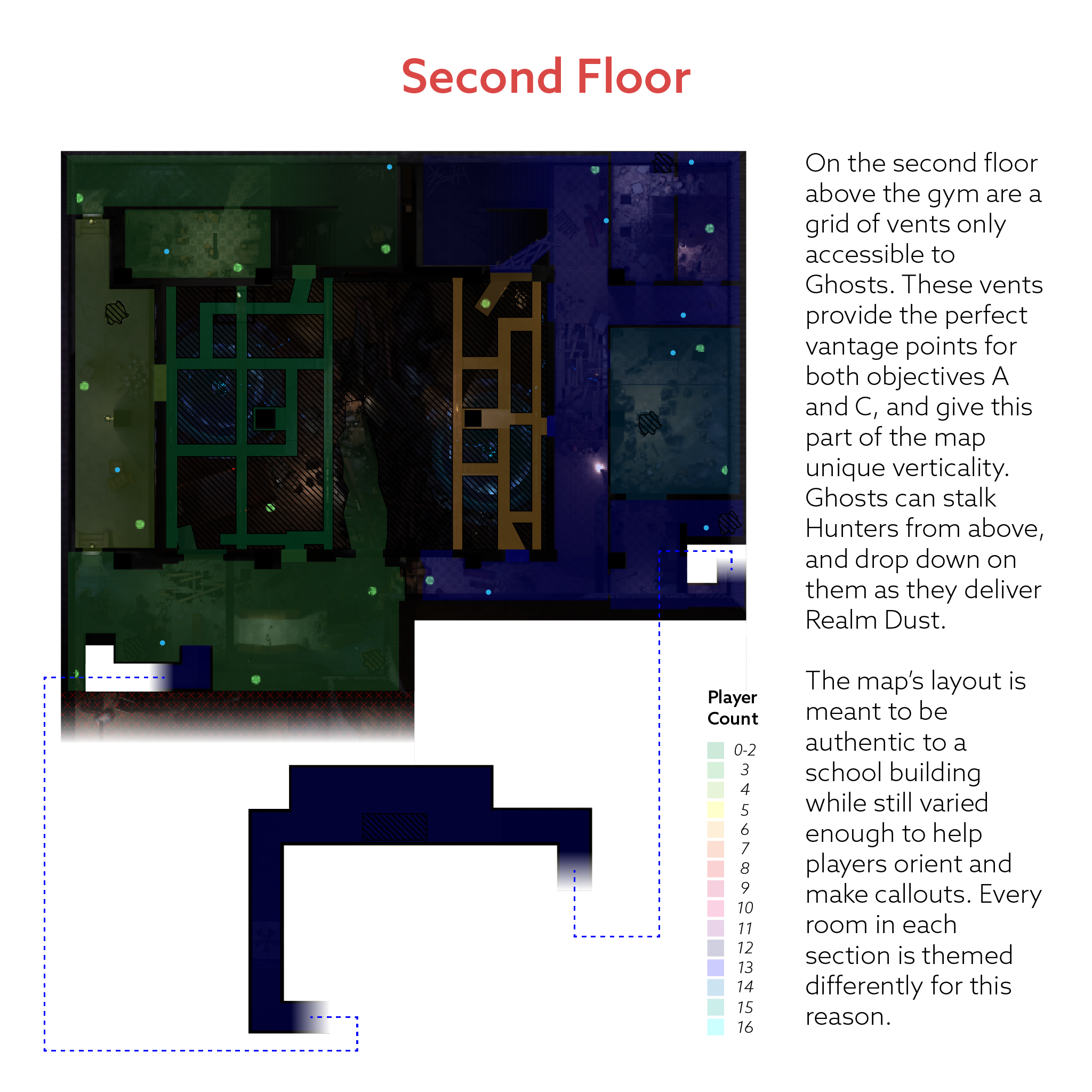
Following the sketch above I created a blockout of the map that I unfortunately did not document and is now so far back in source control I can no longer access it. From that blockout we did expedited playtesting (given out 3-month timeline) and then I and our environment artist tag-teamed all the set-dressing. Below is a deep-dive into the level’s final design.
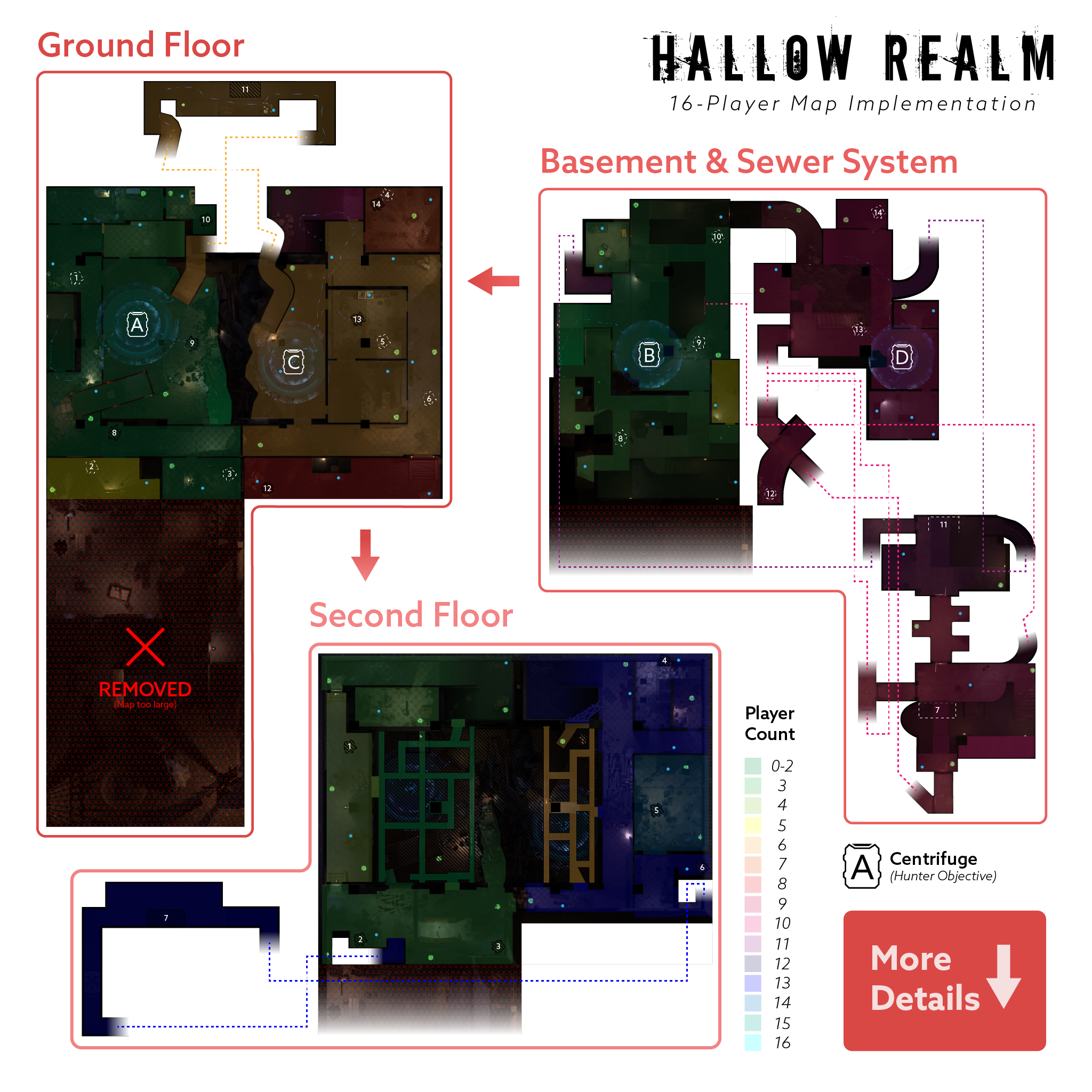

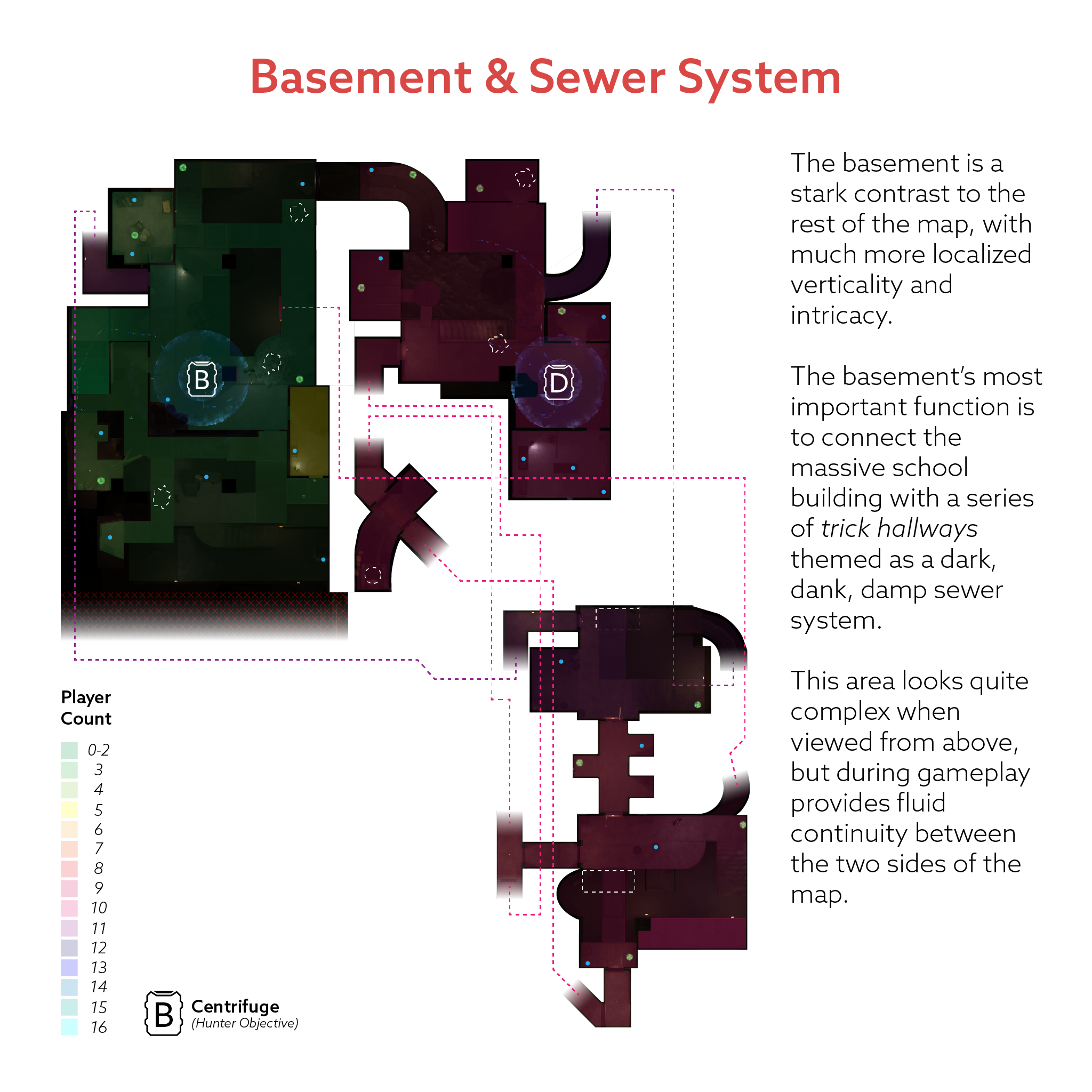
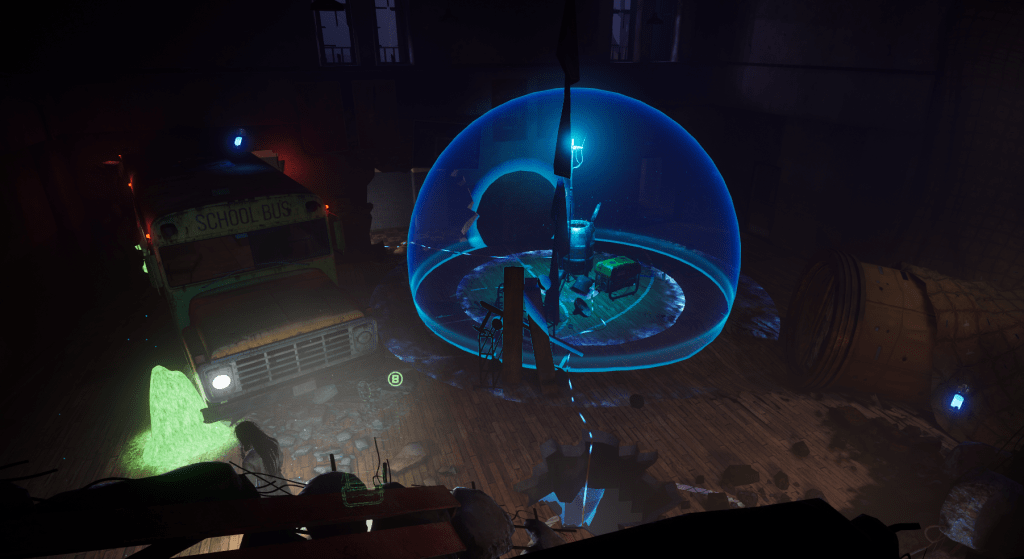
The Hunter objective points (Centrifuges) are all connected via glowing blue wires which help players orient. A massive portion of our players are newcomers and only play a 30-minute session so we did as much we could to remove any barriers to the immersive fun.
One unique aspect of Hallow Realm that is highly consequential to its level design is its spawn system. When a player dies they remain standing where they are, they are shown a progress bar on their HUD, and they have all other players hidden from their view. Once this progress bar fills, the player respawns wherever it is that they’re currently standing in the map (meaning spawn points are not designed into the map at all).

This respawn system design choice is a result of the game being an arena-scale VR title—resetting players positions to any spot on the map other than the one they are currently standing in would misalign the game world to the real world and break the careful illlusion of map continuity.

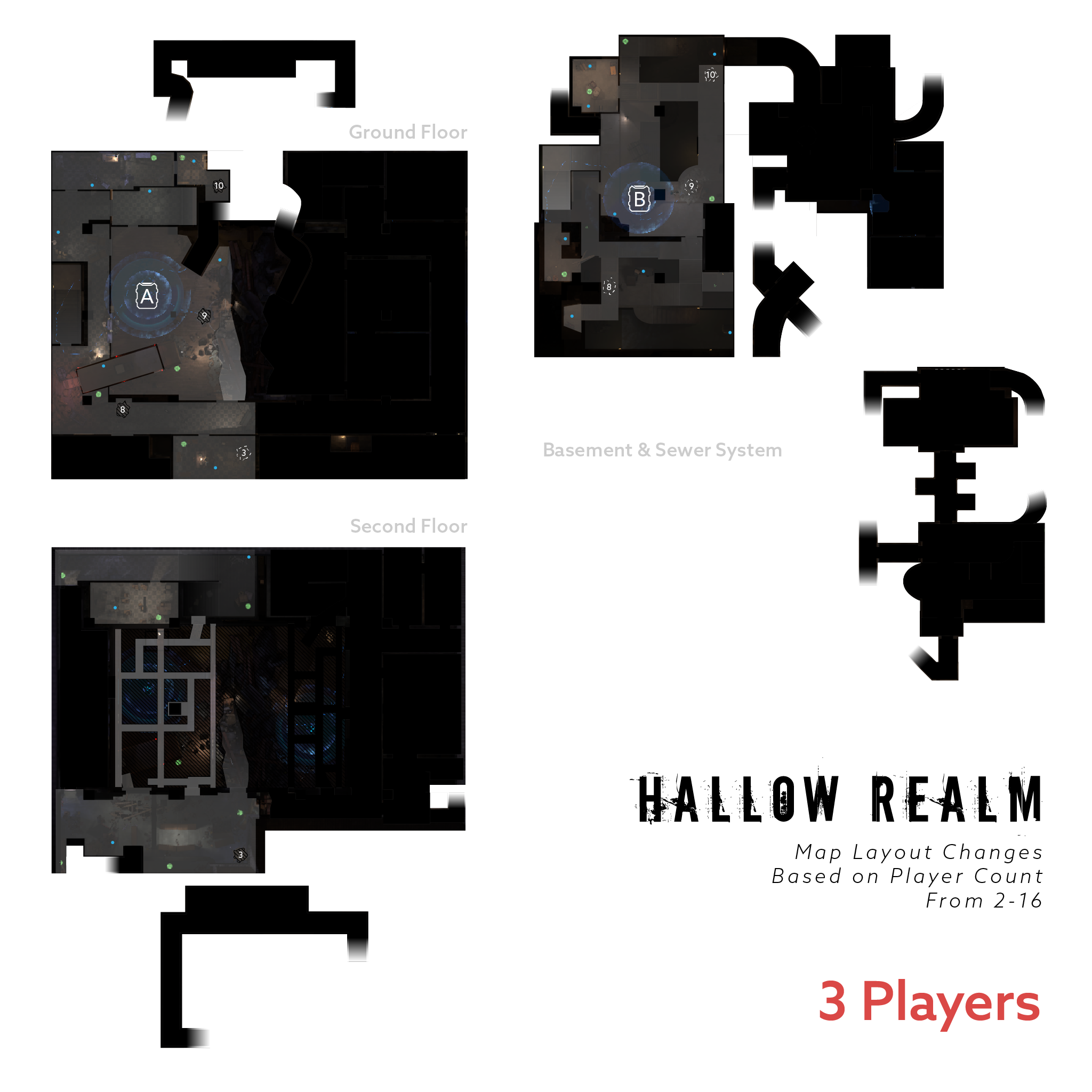
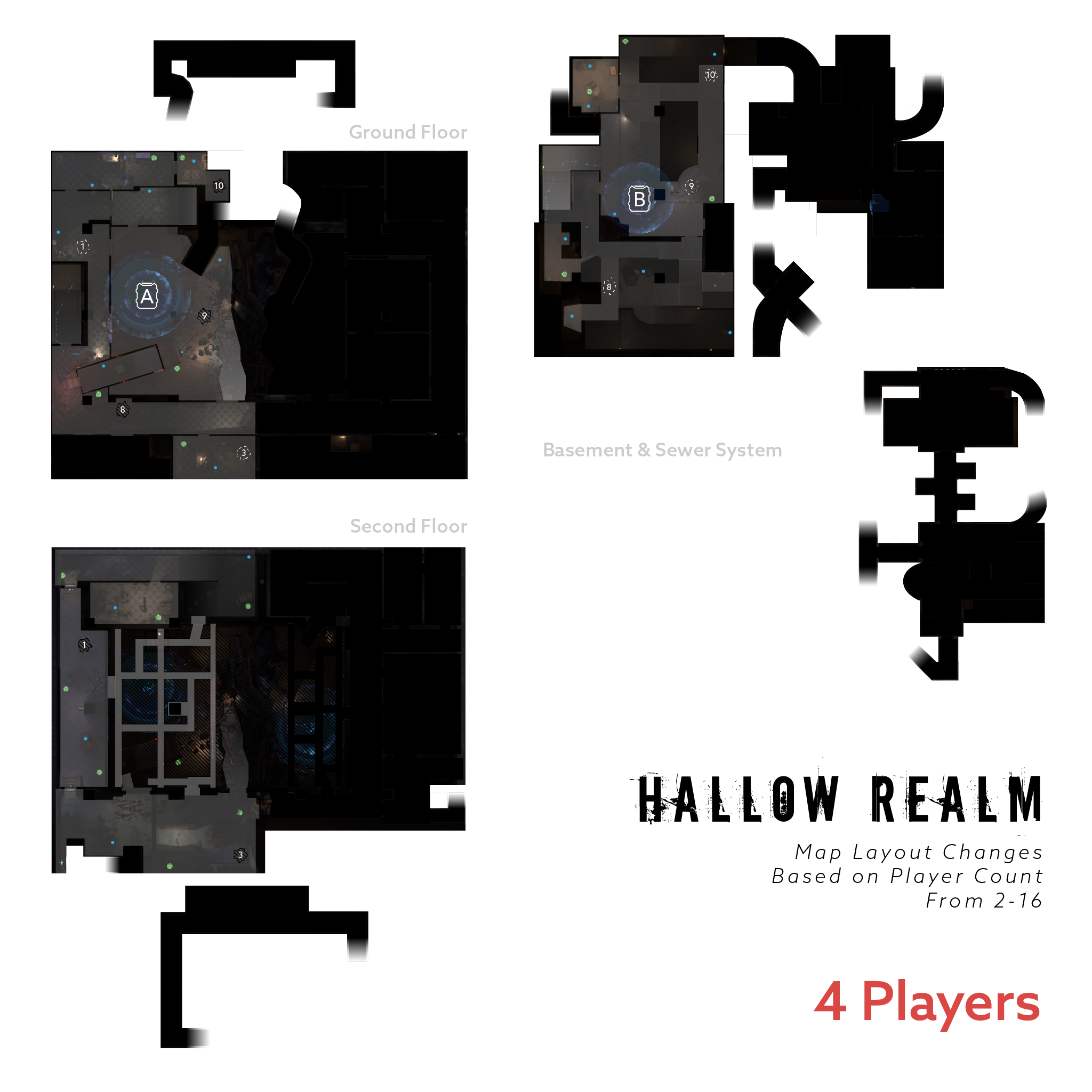
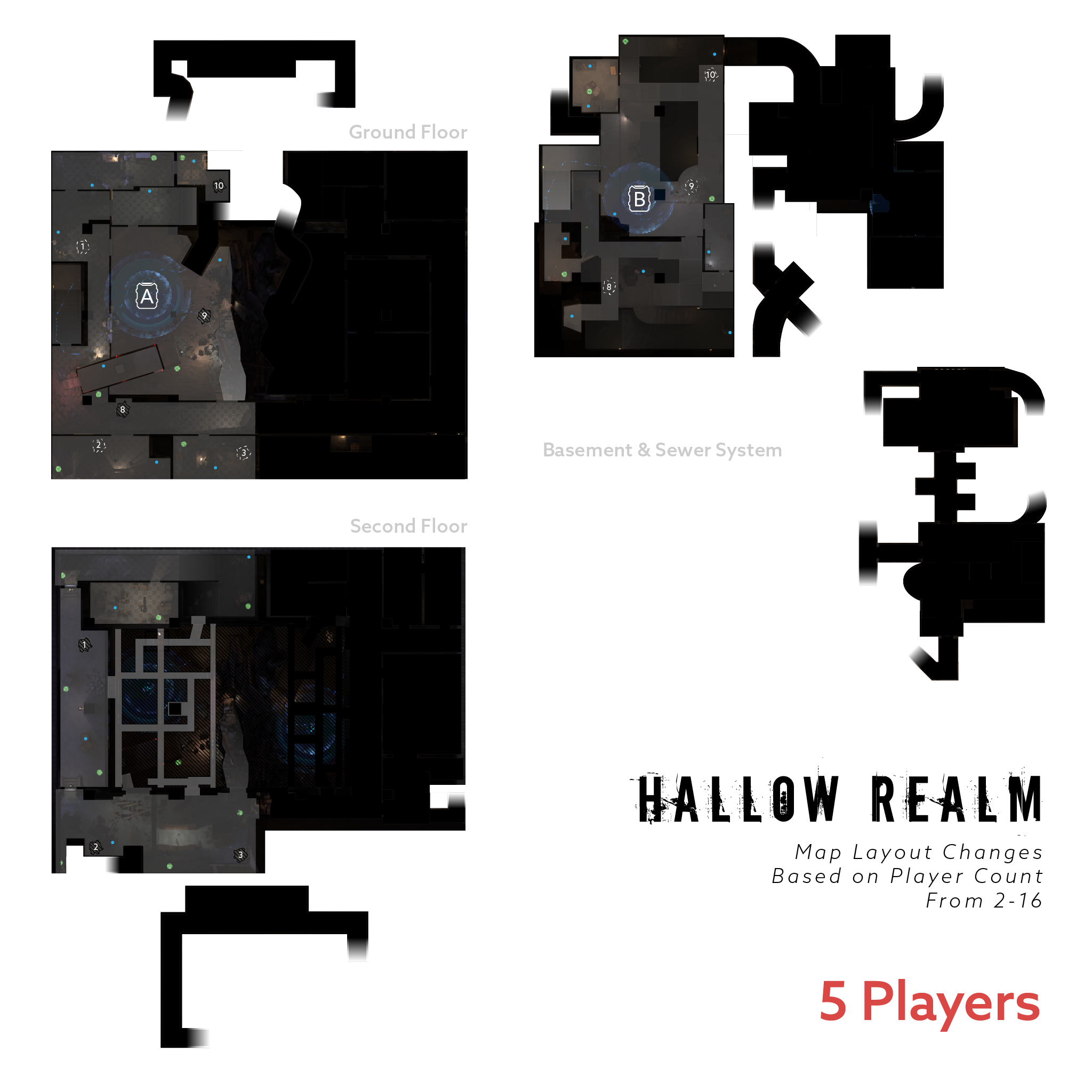
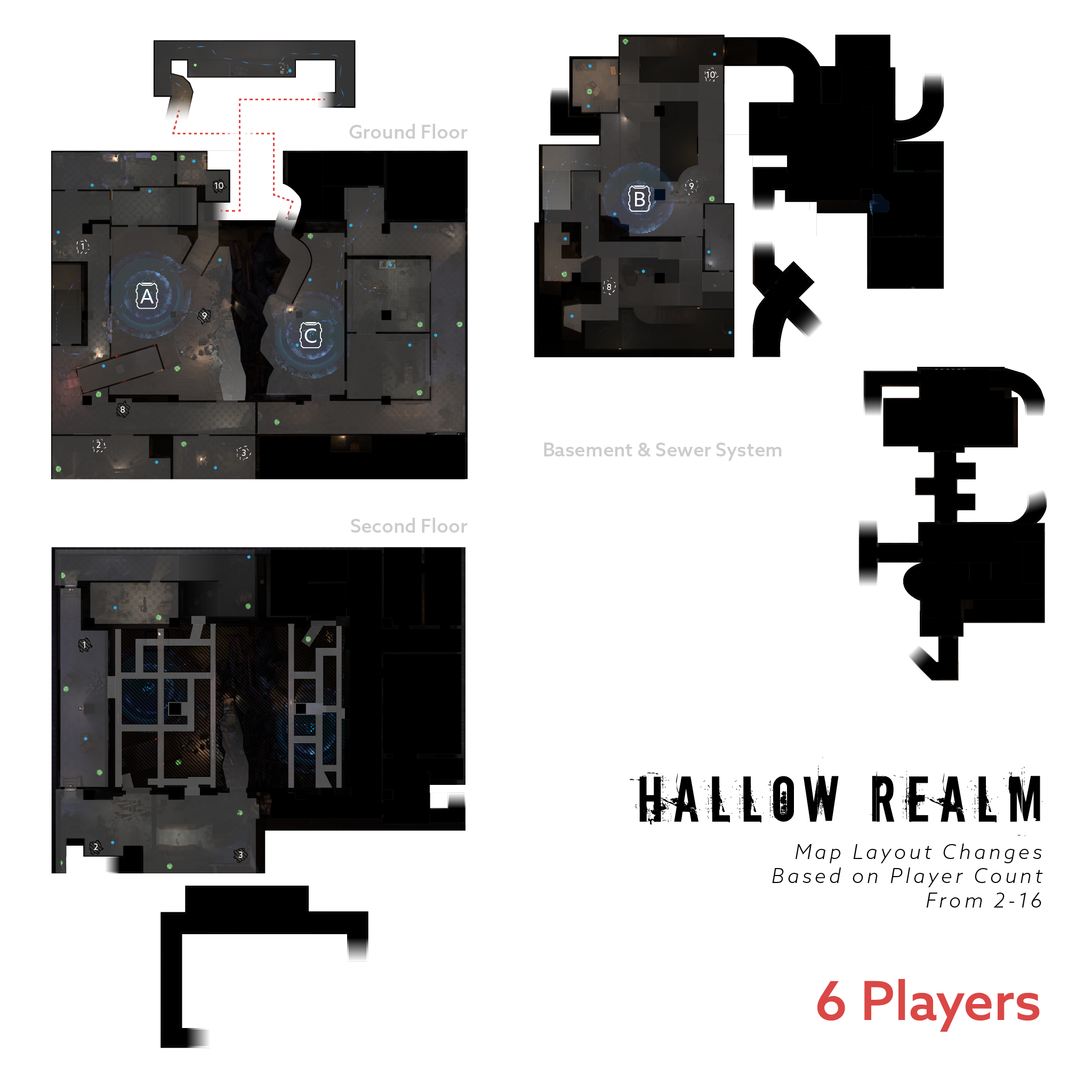
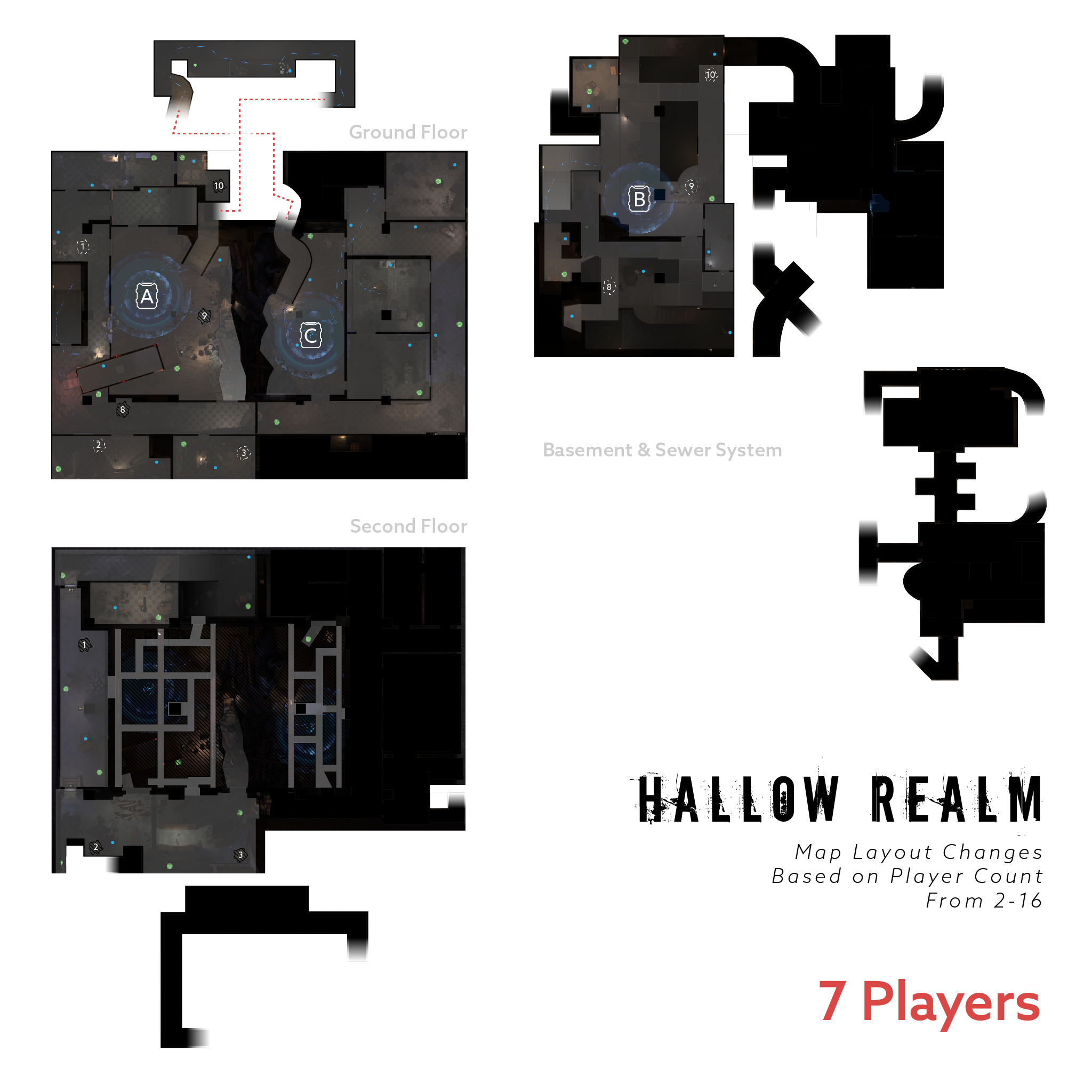
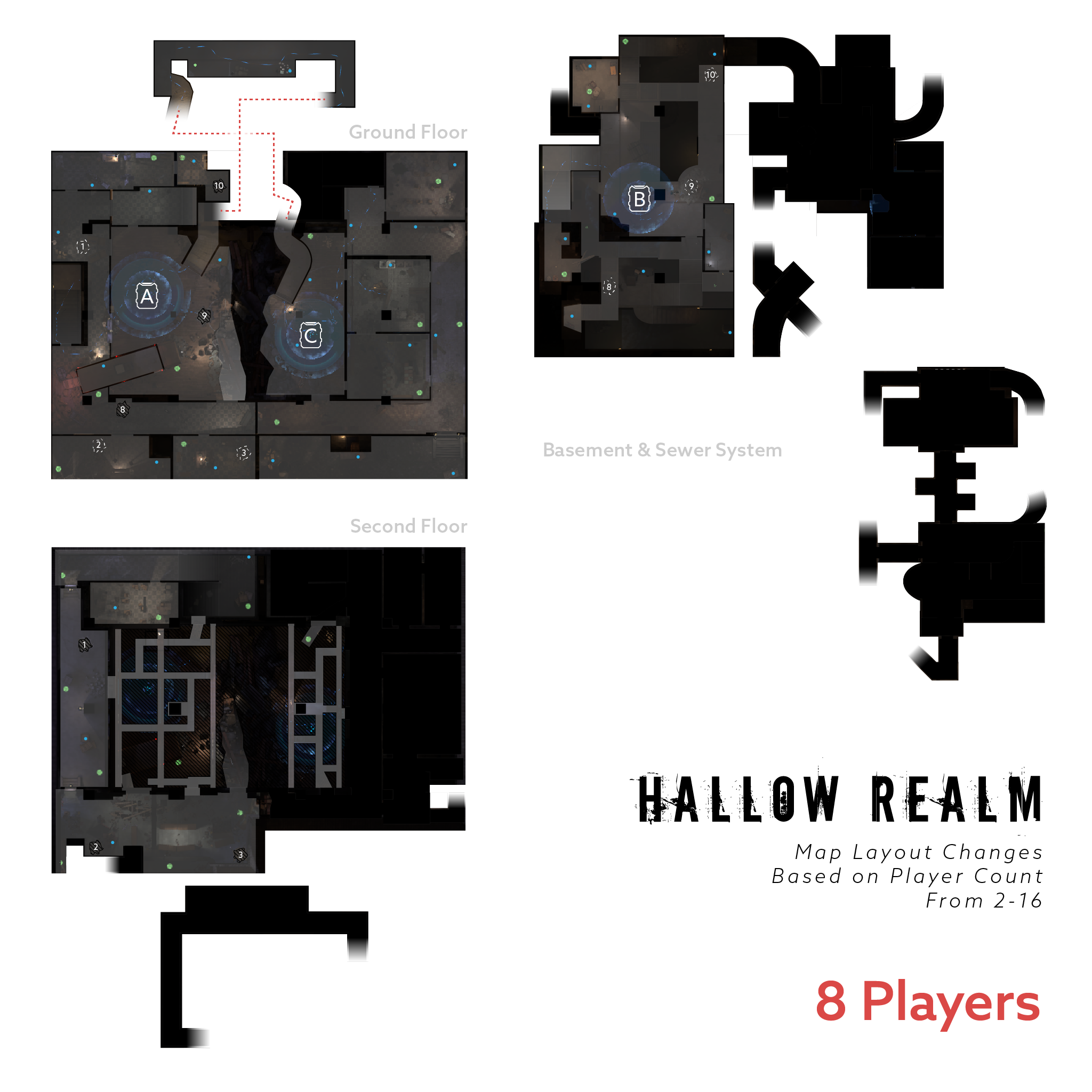
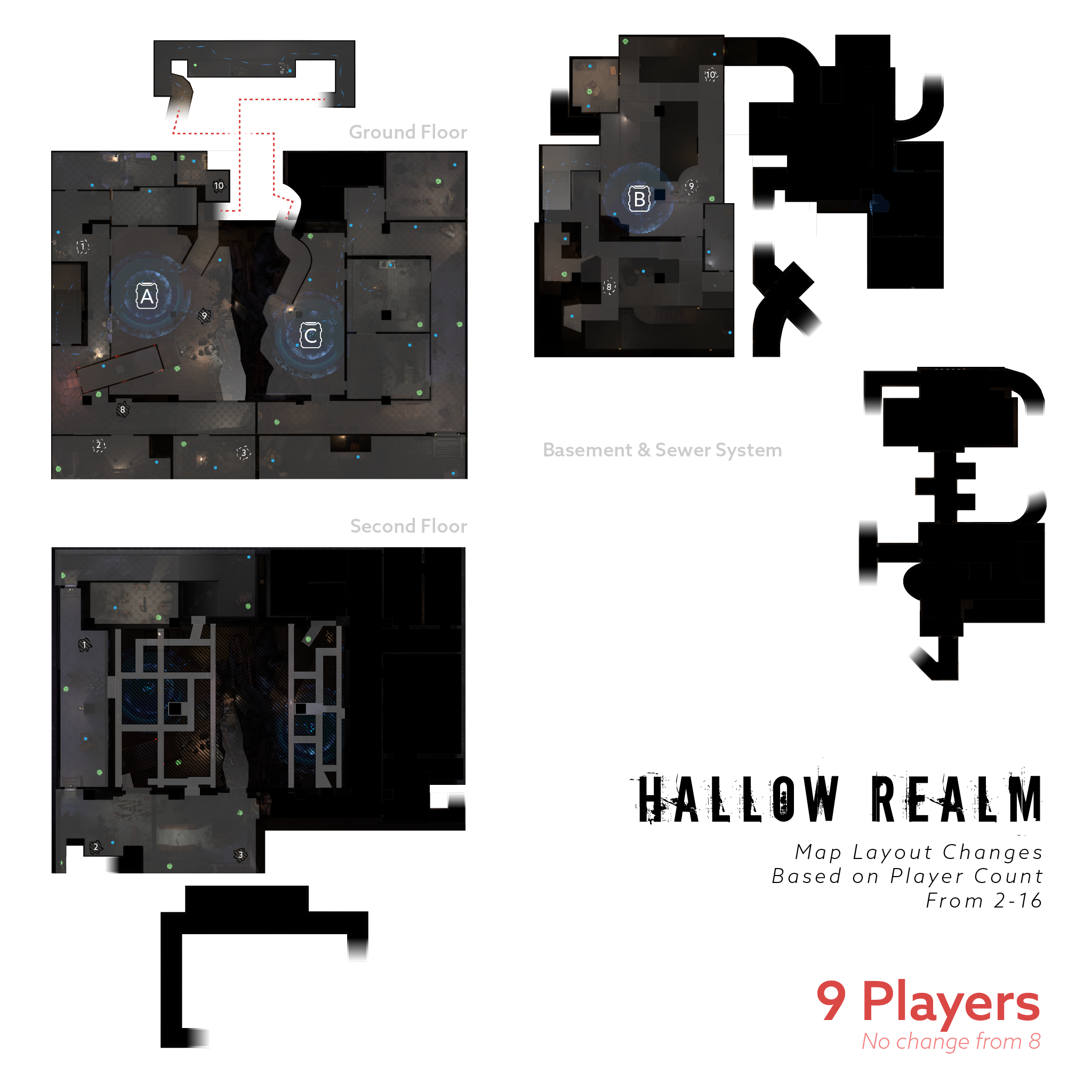
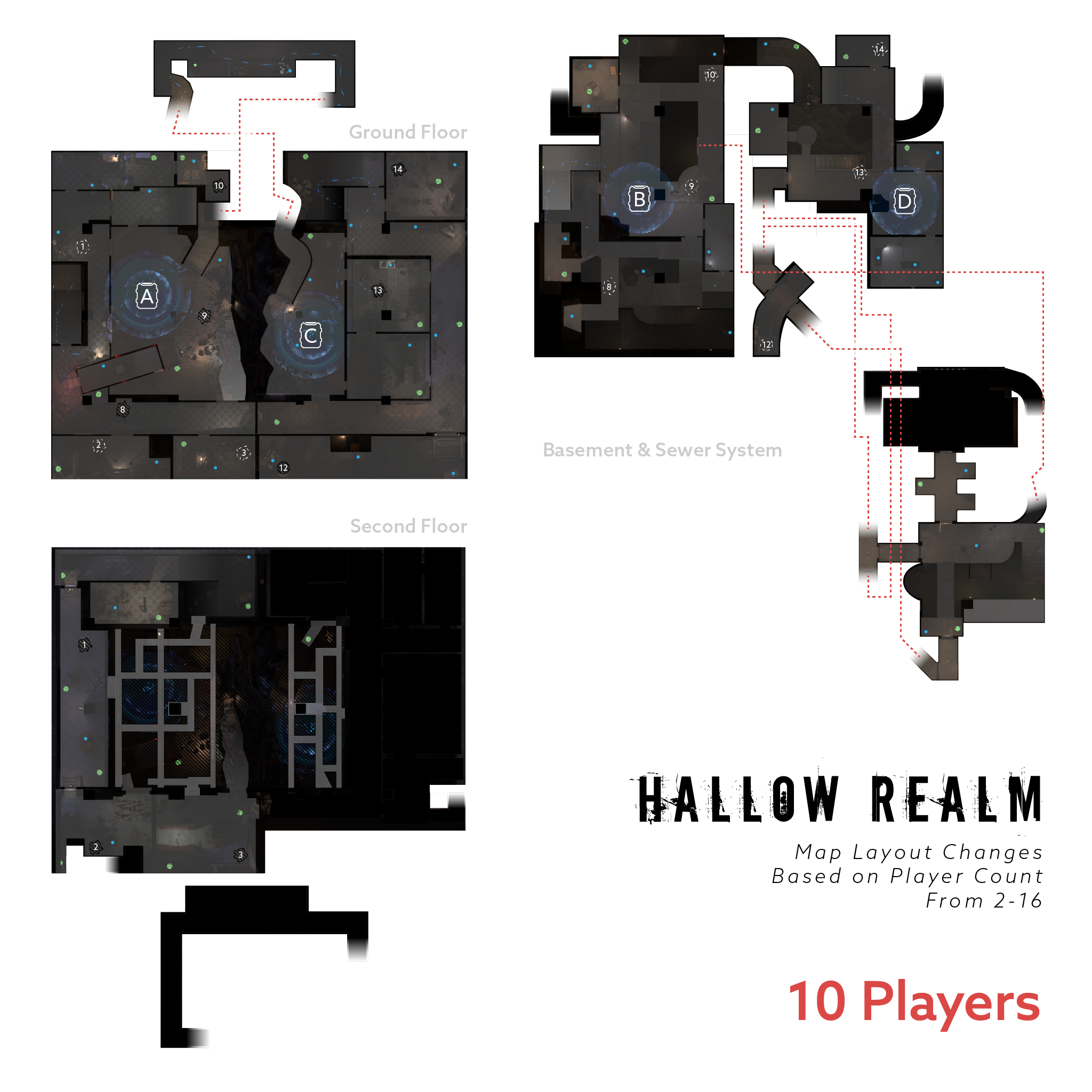
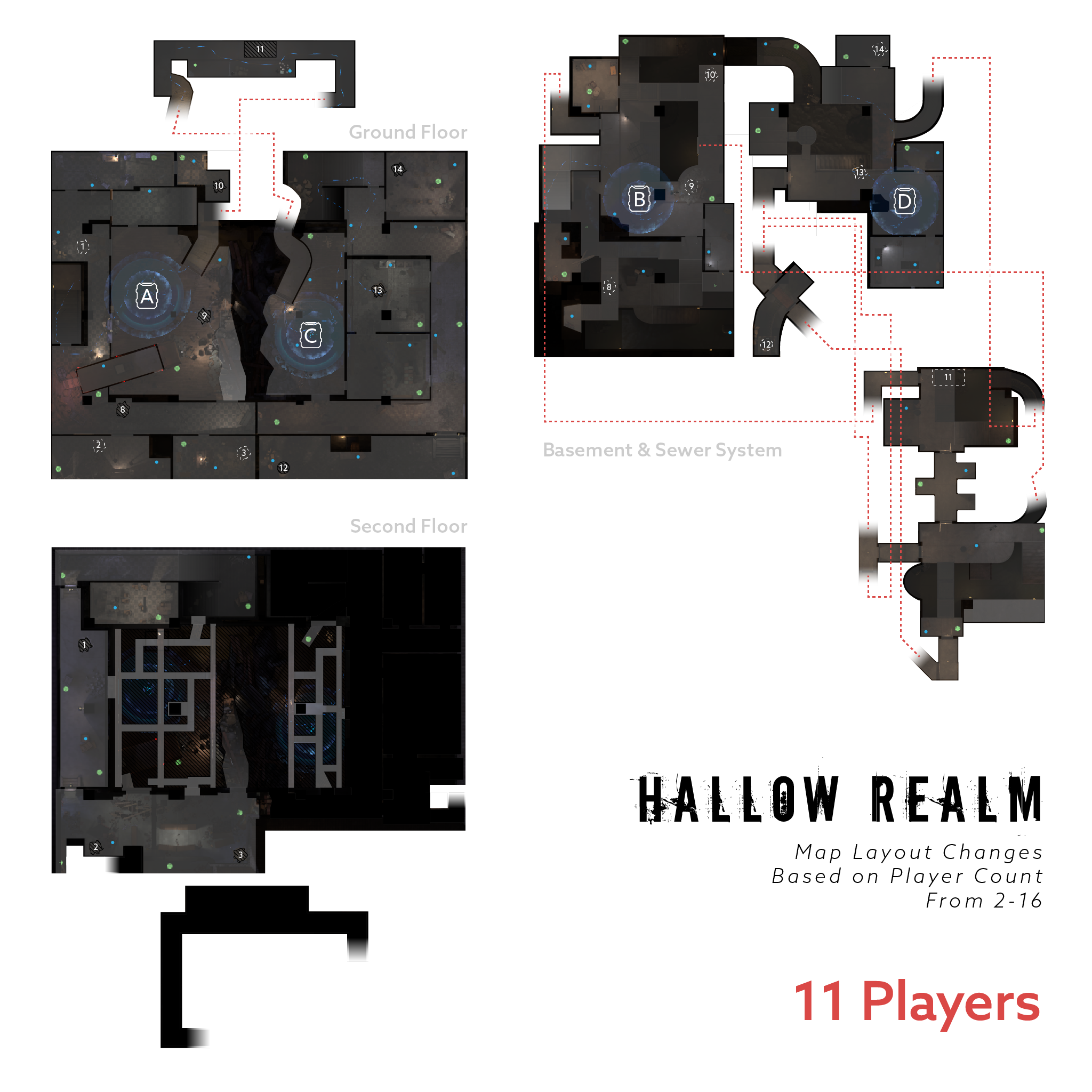
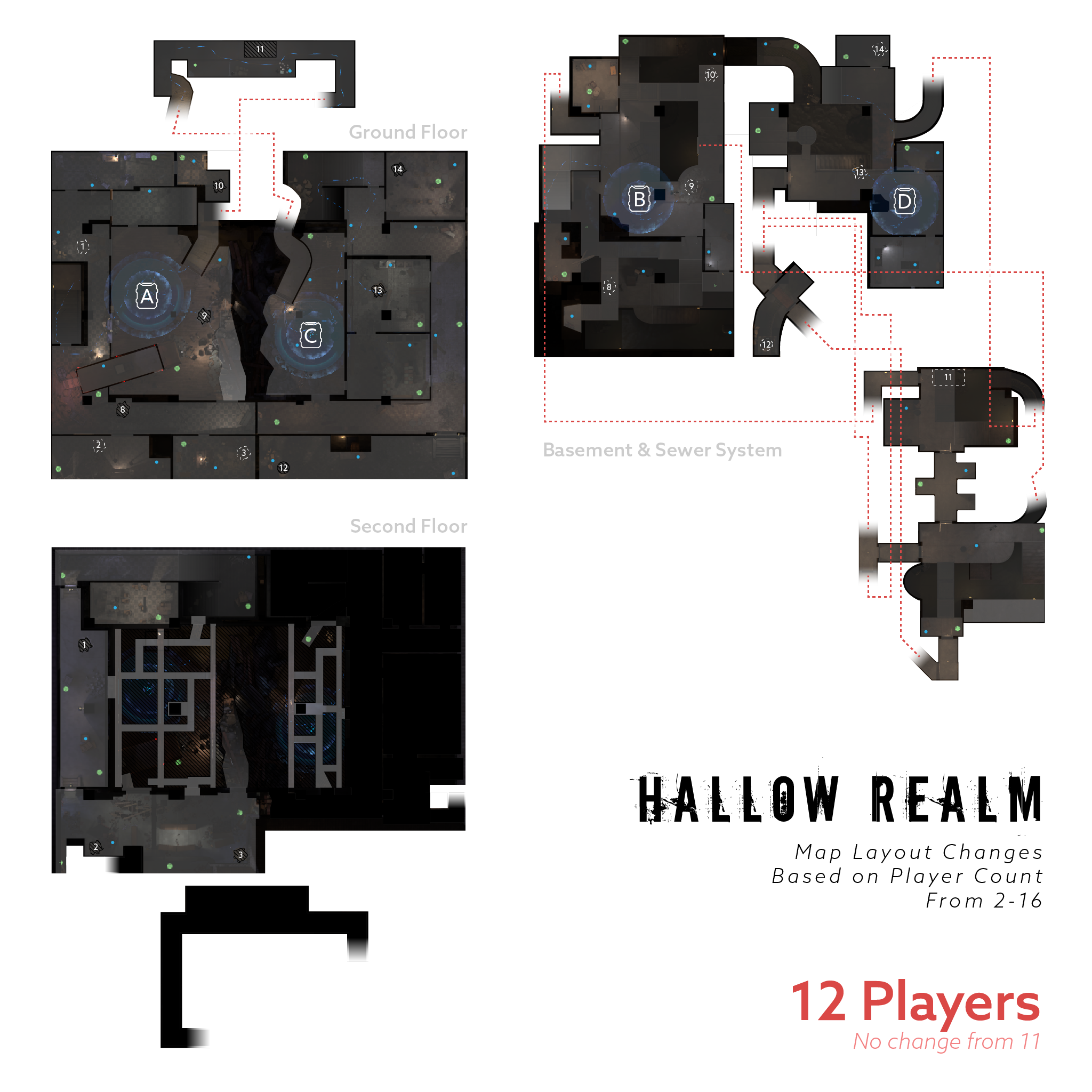


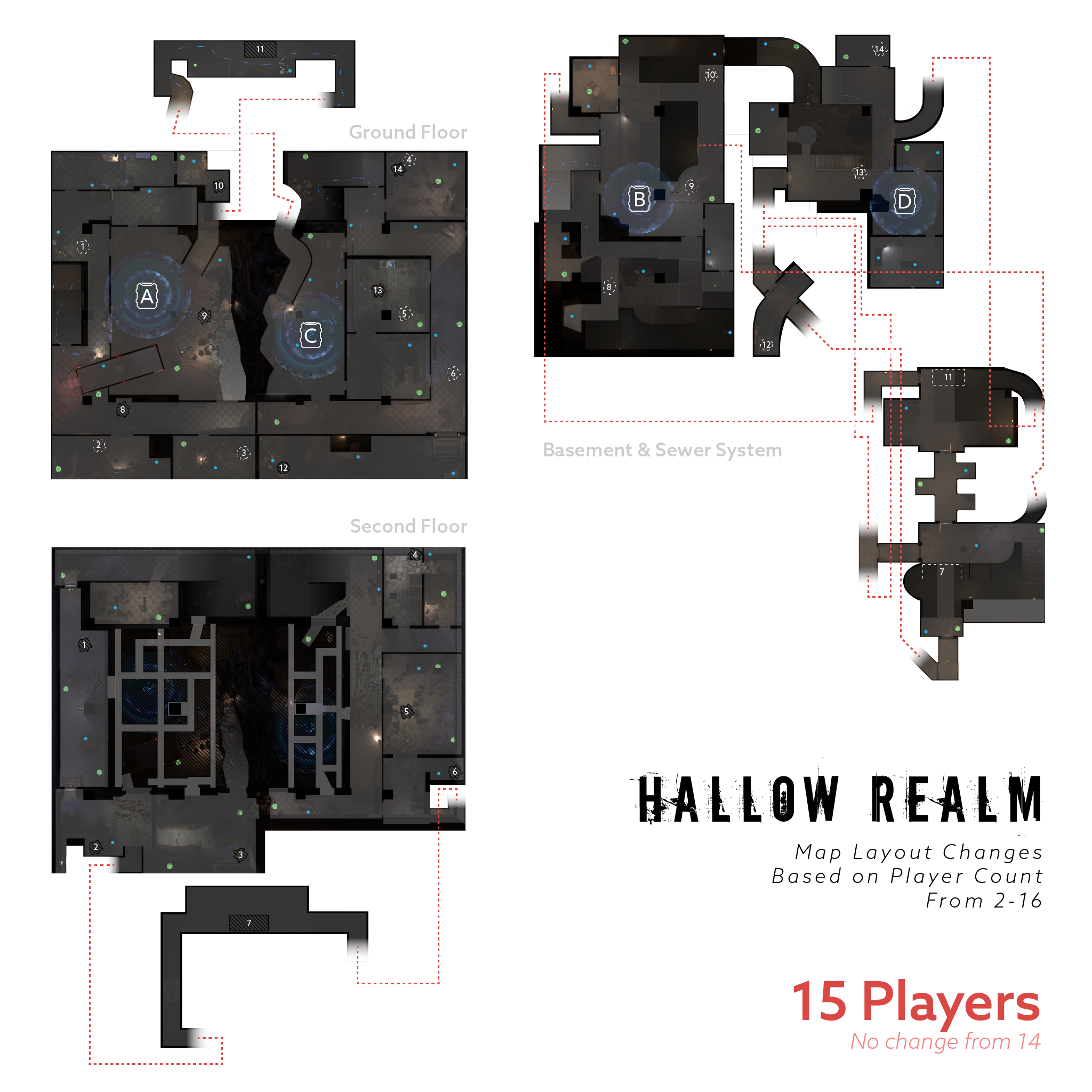
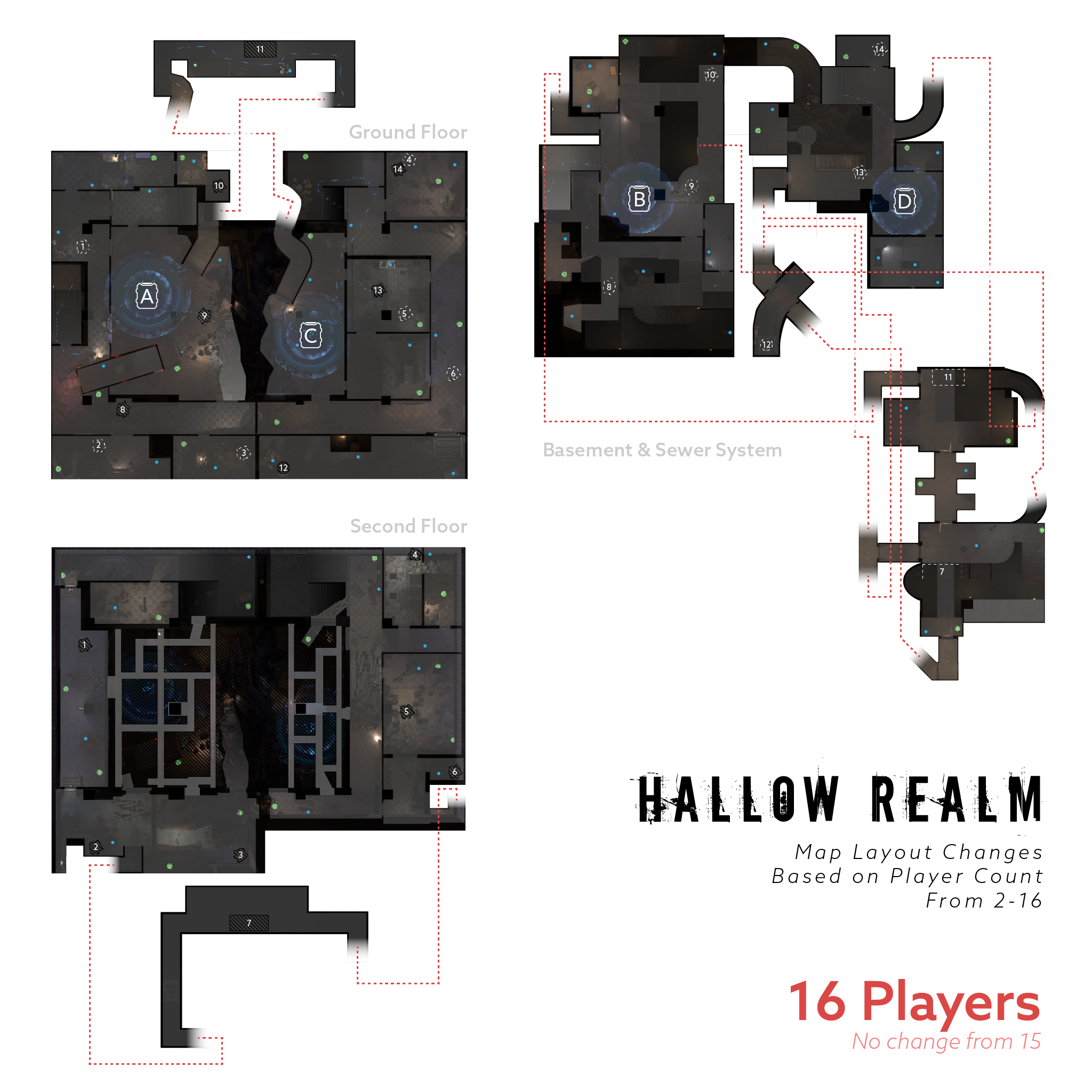
Player Count:
Objective Mode Game Design
Hallow Realm shipped as a basic team deathmatch game (a consequence of the expedited 3-month timeline). The following 3 months I spent working closely with 1 programmer to design, implement, and refine an objective-based game mode for the game (in addition to various polish, bug fixes, and performance patches).

I started by determining our design goals, and then got to brainstorming! Below I’ll outline the process I took to refine our game mode design and ship the final version.
Design Goals
- Provide a concrete sense of success or failure at the end of the two rounds (each team plays 12 minutes as Ghosts, and 12 minutes as Hunters—they pay for a 25-30 minute game session)
- Conclude each round as close to the 12-minute mark as possible to maximize value for players
- Encourage intentional map exploration that results in increased player map knowledge
- Devise rules that are simple enough for even the most layman player to immediately grasp
- Retain sense of tension and horror core to the combat design
- Provide a non-combat gameplay options for inexperienced or inept players
Design Brainstorming
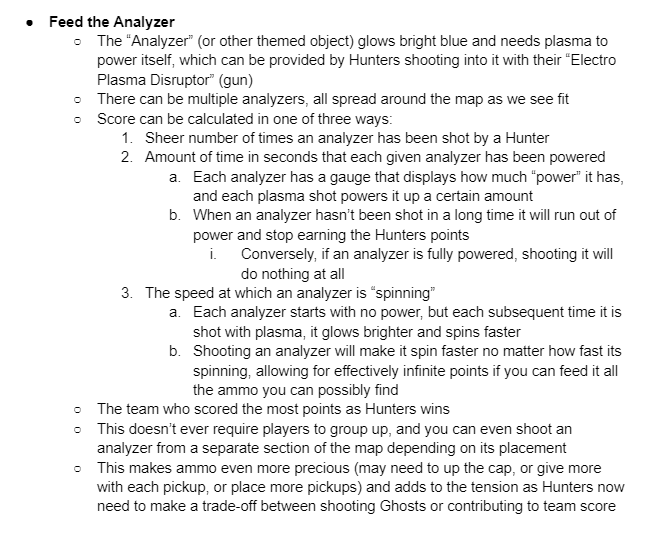
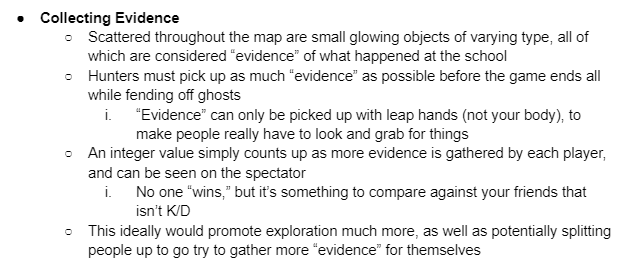
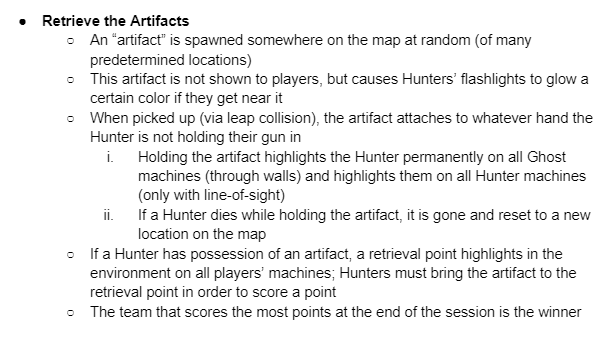
After a bit of brainstorming I came up with 5 possible game modes pitches, and naturally—in accordance with design goal #3—we chose the simplest one.
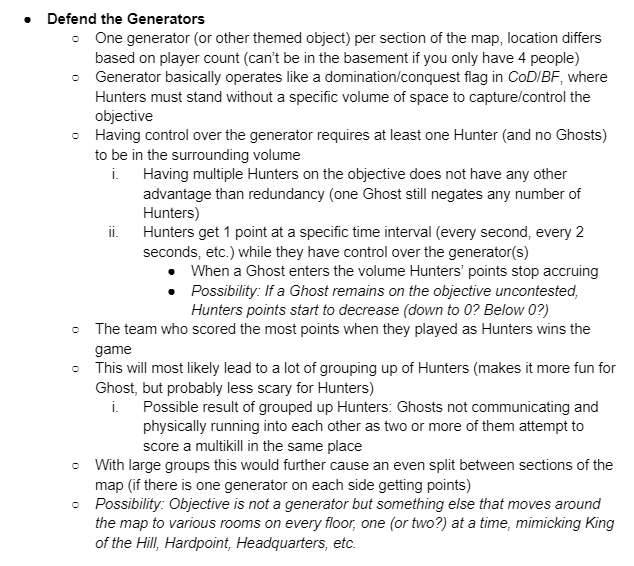
What we decided on

Just collect resources and deliver them, simple as that! This hit all of our design goals:
- It provides a clear success/failure state that isn’t a direct score competition between the two 12-minute rounds
- It encourages map exploration by spreading resources throughout the open parts of the map
- It is incredibly easy to understand for players new and old (especially first-timers hopping into a 30-minute session): just pick things up and deliver them
- It increases the general sense of purpose and determination Hunters feel to accomplish their goal and adds larger stakes to death, likely leading to even louder shrieks of terror (it did)
- It provides a viable non-combat play style to complete the goal without completely discouraging combat for more aggressive or skilled players (it is always helpful to kill Ghosts)
Now that we had the skeleton (pun intended) of our game mode, it was time to carefully consider every detail and edge case. Below are some of the tweaks and additions I made to the mode’s design to (hopefully) best achieve our design goals:
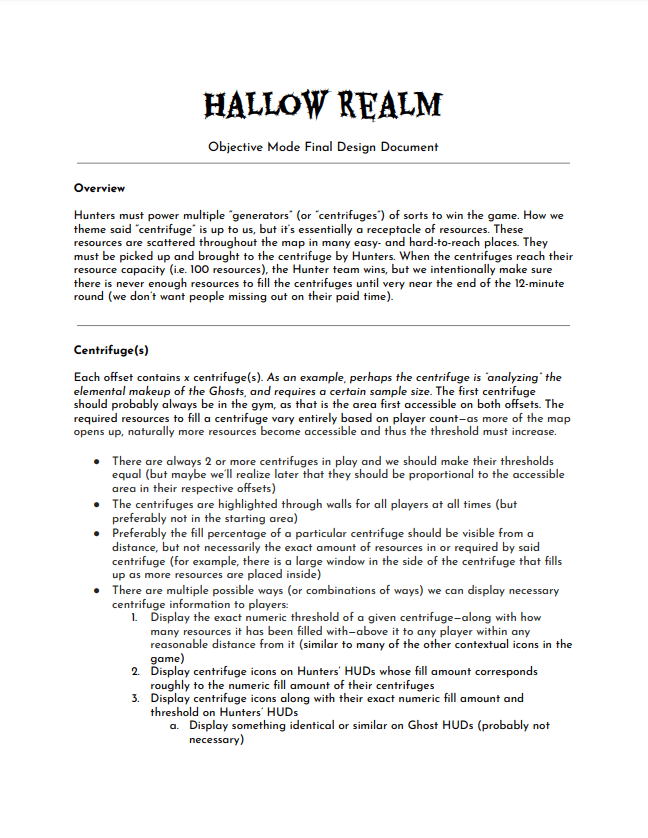
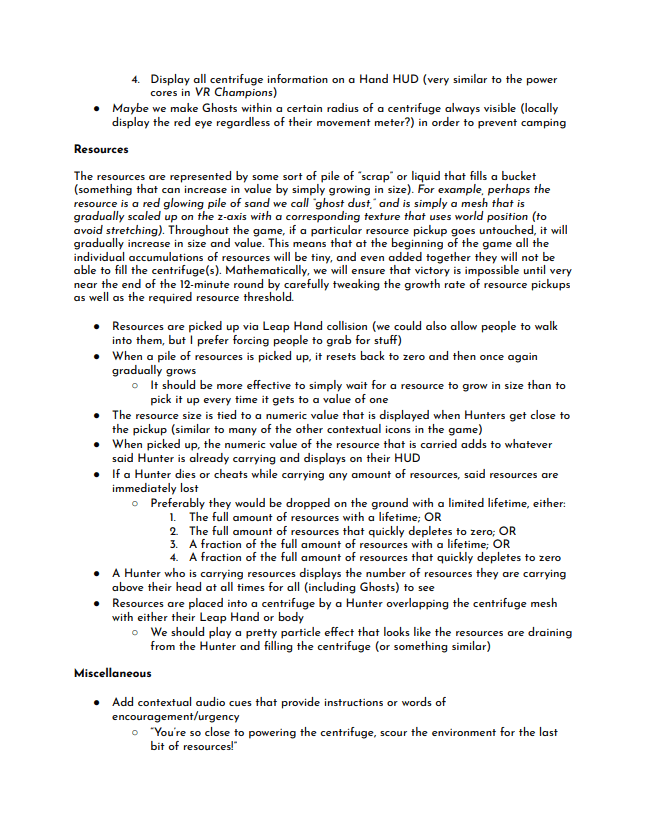
- Throughout the game, if a particular resource pickup goes untouched, it will gradually increase in size and value. This means that at the beginning of the game all the individual accumulations of resources will be tiny, and even added together they will not be able to fill the centrifuge(s).
- This also means that untouched resource accumulations will be massive by the time someone finds them, further incentivizing exploring the less traveled sections of the map.
- There are always 2 or more Centrifuges (“generators”) in play to further encourage exploration and Hunter players splitting off from one another.
- The Centrifuges are highlighted through walls for all players at all times (make sure no one will ever get confused about their location)
- To further hammer this home, each of the Centrifuges is connected to the others via glowing wires that provide a golden path for lost players
- Employ what I called the “Mario Kart approach” and increase or decrease the challenge depending on player performance—silently tweak the growth rate of resource accumulations in order to ensure players complete their goal with as little time left in the 12-minute round as possible
- Play contextual voice lines at key moments to reinforce game mechanics and aid inexperienced players
Below are screenshots of the final design for this mode. The full document is 12 pages long and includes a basic lore background to theme the mode around as well as dozens of contextual voice lines, all of which shipped with the mode.
Side Note: Blueprint Code
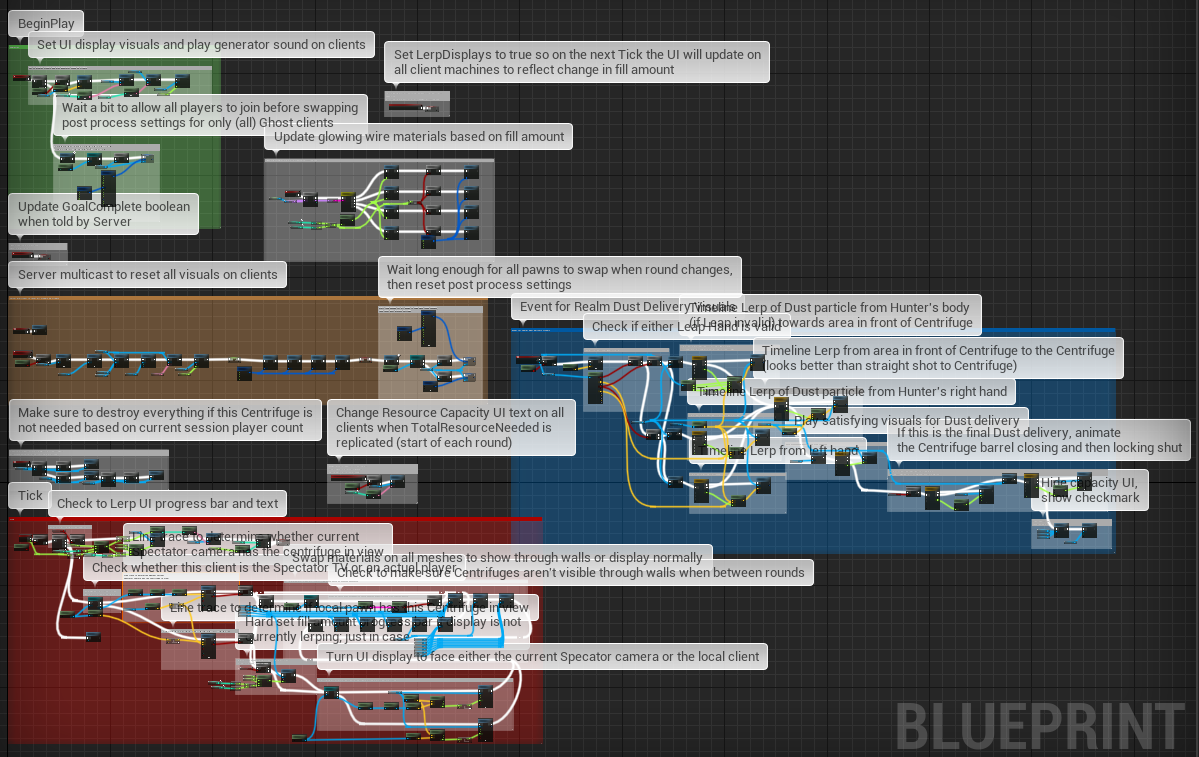
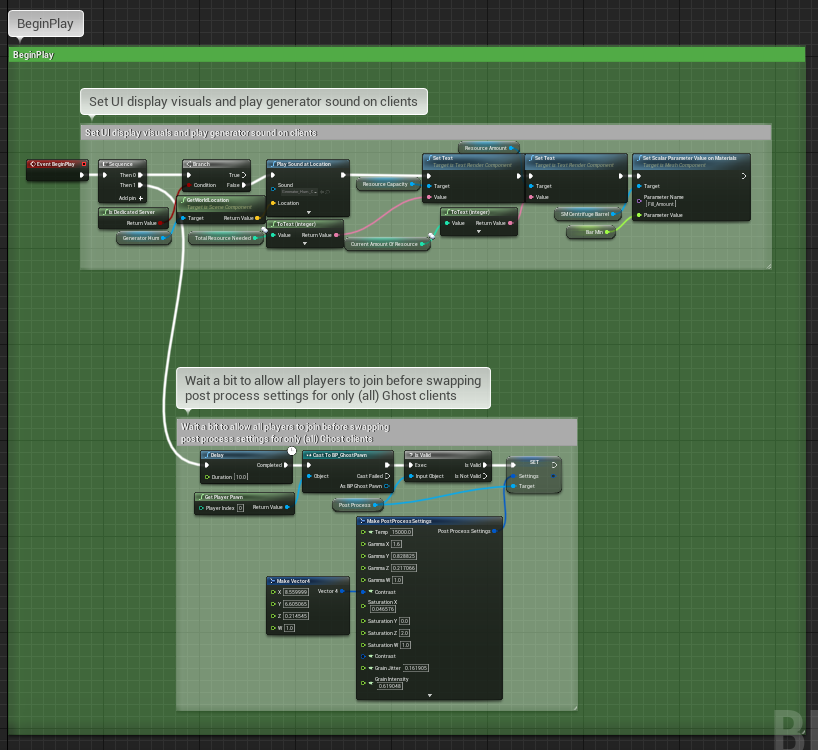
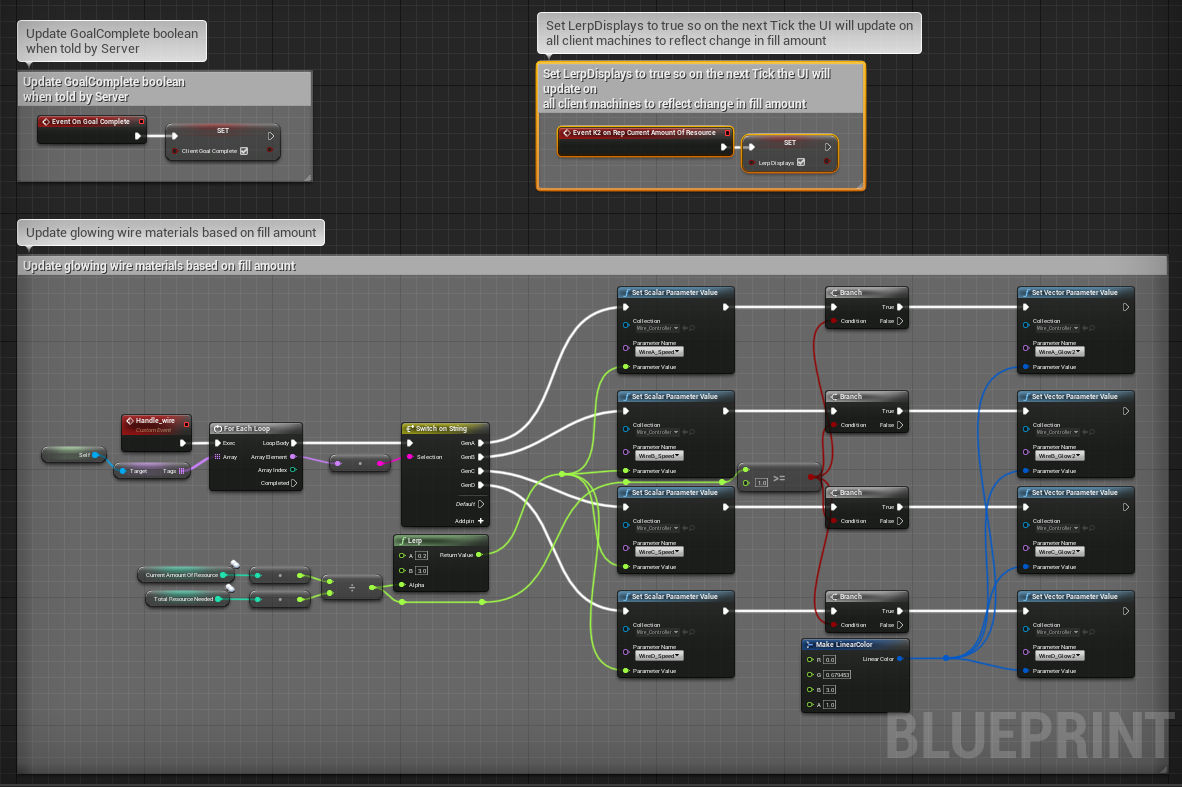
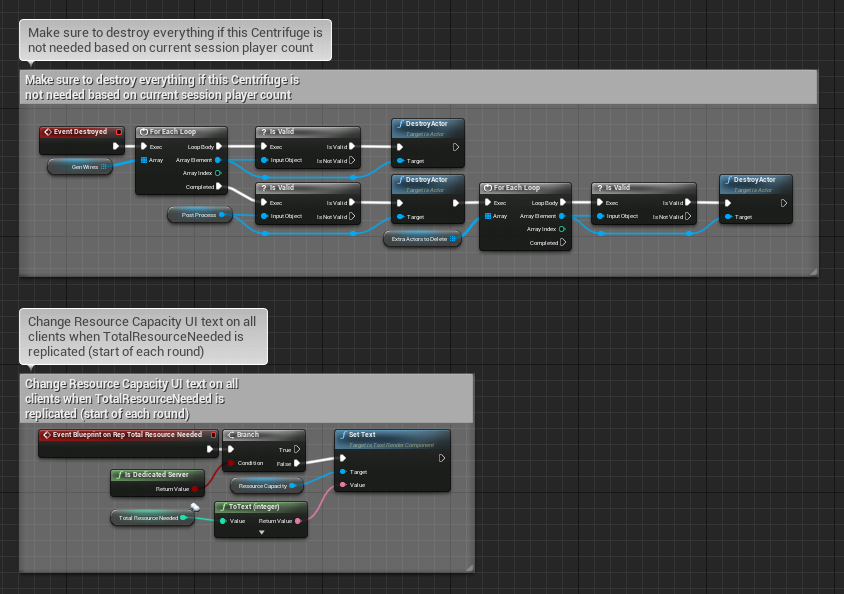
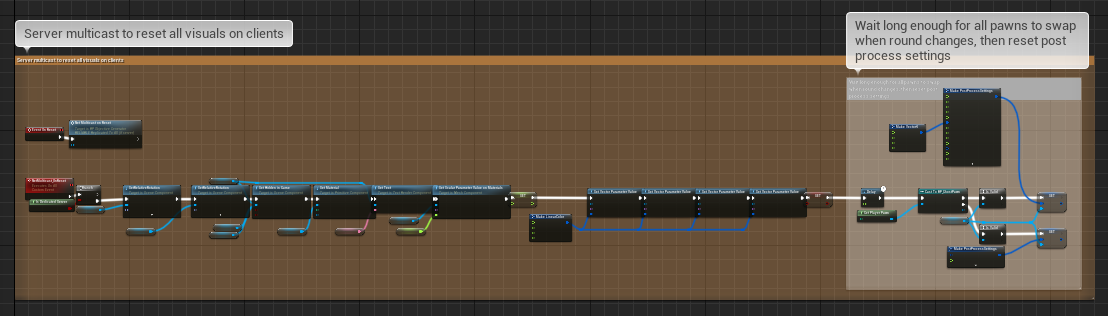
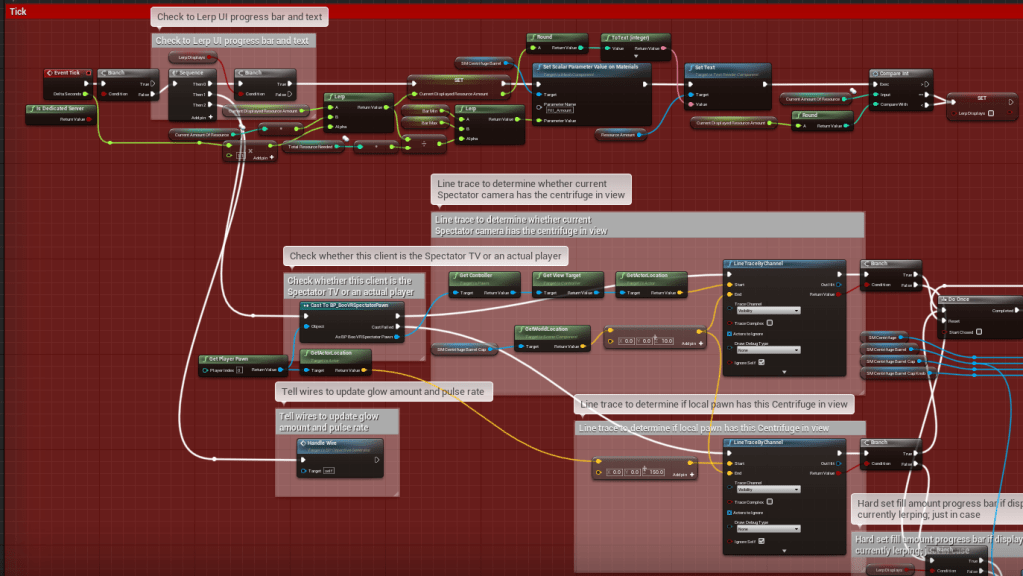
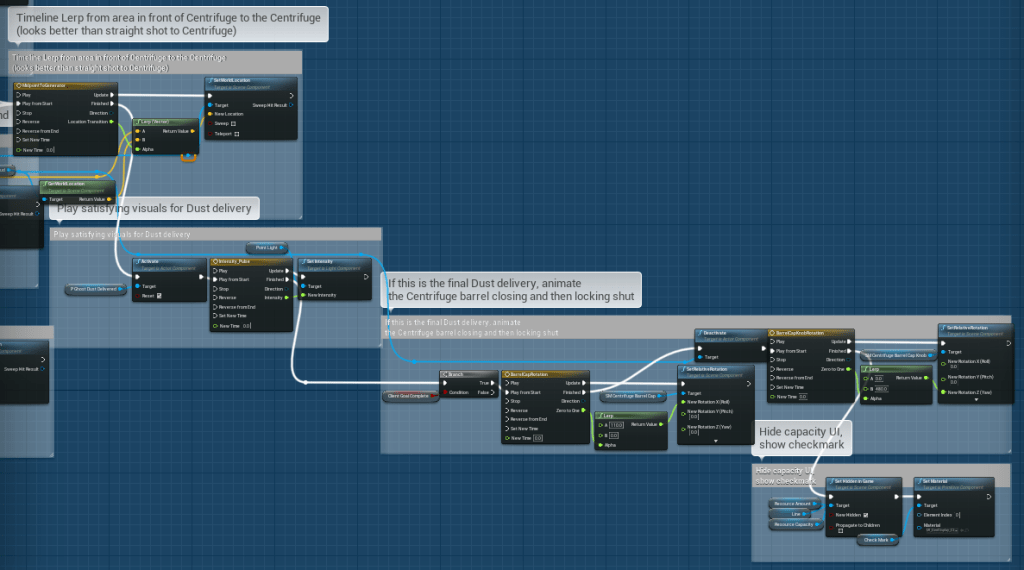
In addition to designing the mode I worked with a programmer to implement and test it. He handled C++ and I handled Blueprint. Below is my Blueprint code work for the mode’s Centrifuge. I also coded the Realm Dust pickups, and created the meshes and particles involved with both.



Fast forward to release and players are having a ton of fun, us included. Only problem is that our win rate is catastrophically low! I recorded the relevant stats from the few dozen game sessions we’d held and only one team had successfully filled all the Centrifuges! Given only a single weekend it was clear it was way too hard for Hunters to achieve victory, so a tweak was in order.
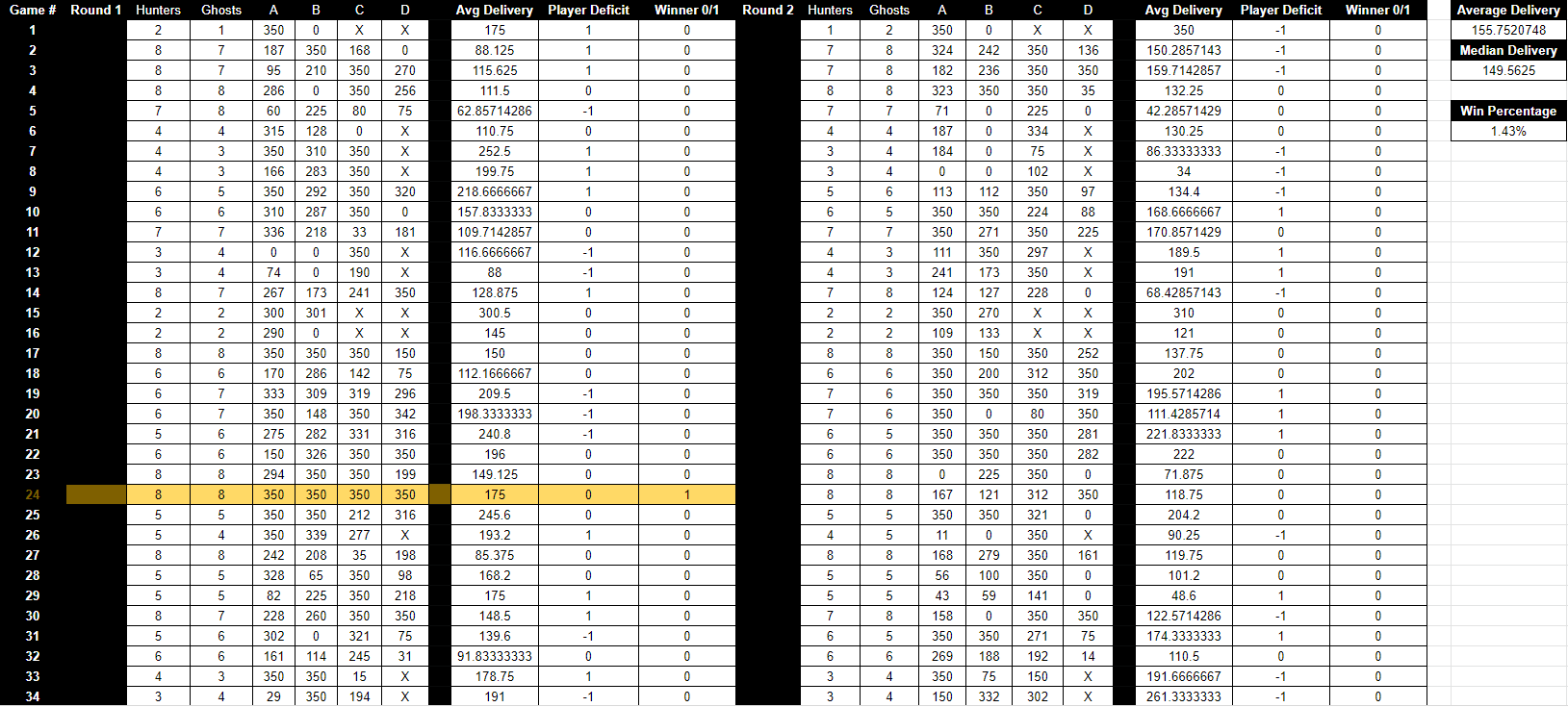
Win Percentage: 1.43%
This is paltry, but we’ve got a clue in the data: our average delivery is ~156 Realm Dust and our median of ~150 isn’t very far behind. Perhaps instead of blanket setting every Centrifuge’s capacity to 350 Realm Dust, we should dynamically shift that value based on the number of Hunters? 180 seemed like a great sweet spot—above the average but achievable enough to motivate people.
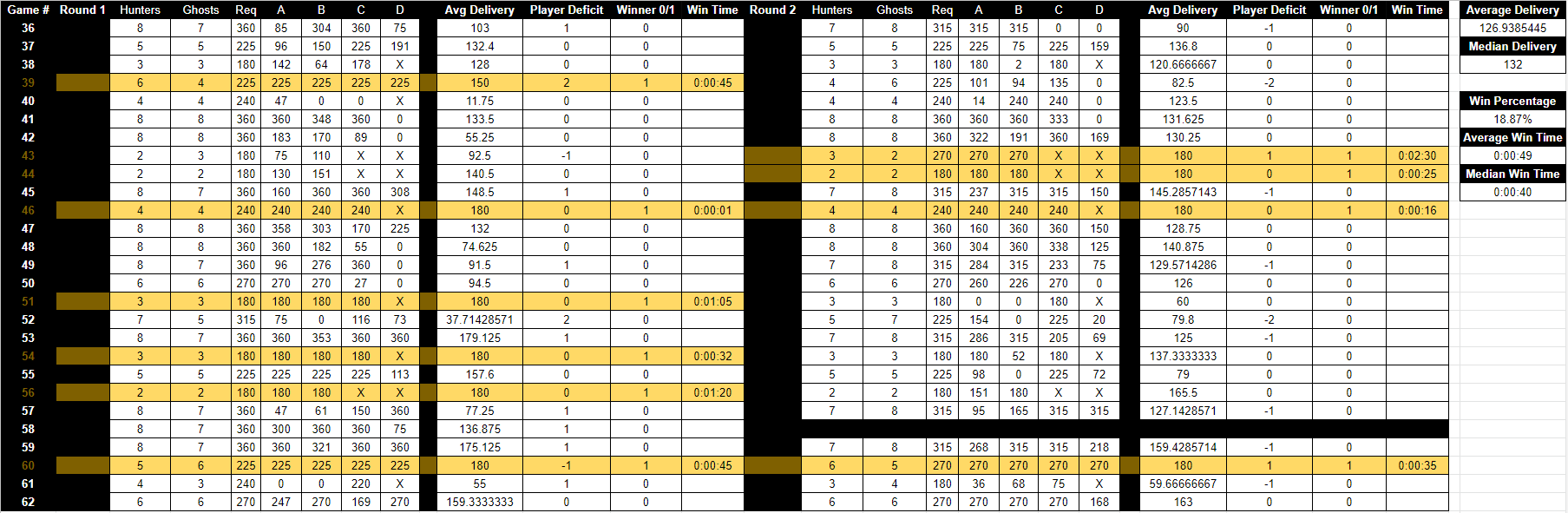
Win Percentage: 18.87%
Median Win Time: 00:40 left
Okay, much better, but not quite there! Not only should this objective be a bit easier to achieve, but nearly all the sessions that have been able to complete the objective have been on the smaller side for some reason. 7/10 of them only have 8 players or fewer—and we support up to 16! What’s going on? Well, as more players populate the map they begin to compete for resources, and are much more likely to form smaller groups than they are to split up and find untouched Realm Dust piles. This leads to diminishing returns as player counts climb toward 16, especially when each additional Hunter is adding 180 more to the collective Realm Dust victory threshold. Looks like it’s time to tweak some numbers again: this time targeted at high player-count sessions.
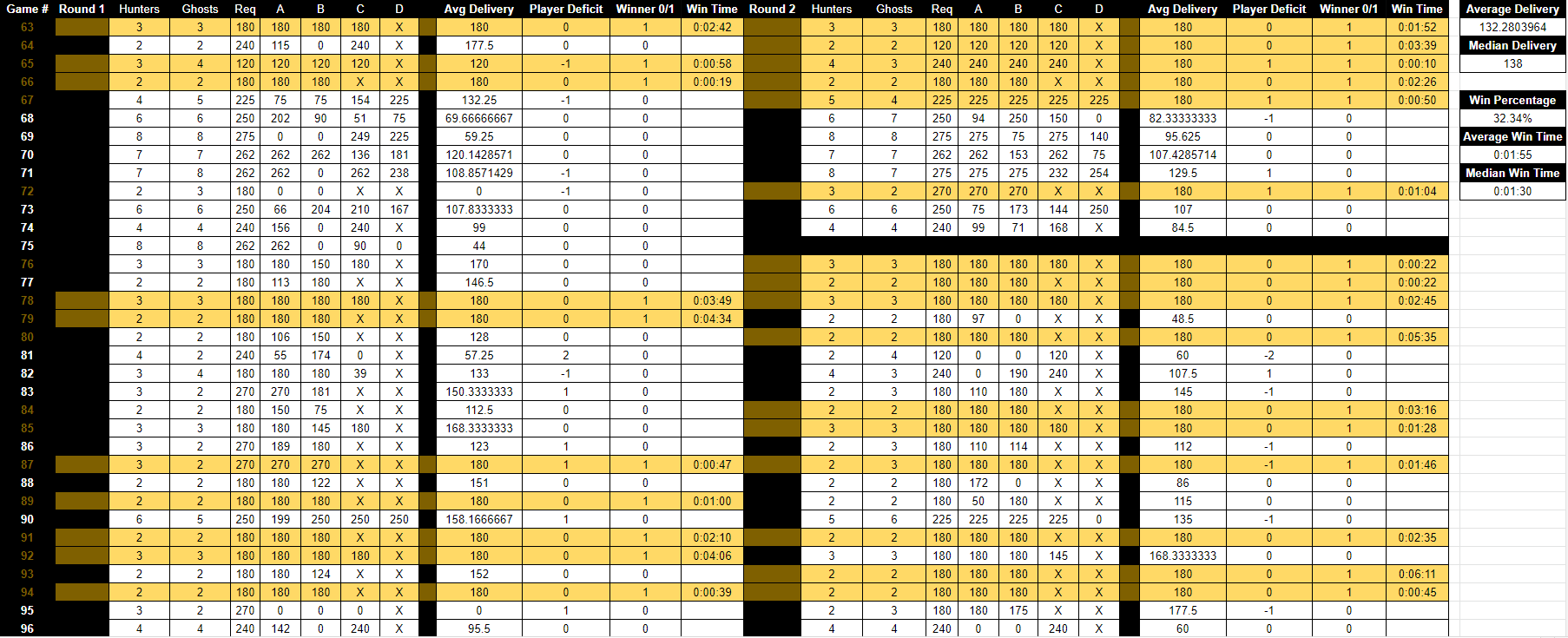
Win Percentage: 32.34%
Median Win Time: 01:30 left
A third of our players are completing the objective—difficult but attainable! This is even better still, though not quite perfect. All players are more likely complete the objective, but our median win time is starting to slip a bit further from the 00:00 mark we want. Outliers like 05:35 or 06:11 are a troubling sign, though extremely uncommon. This is where we settled before COVID hit and have not gotten back to fine-tuning the mode since then.
Final Mode Design & Implementation
- Hunters must collect Realm Dust and deliver it to Centrifuges
- Once all available Centrifuges reach their Dust Threshold the round is over and Hunters win
- If Hunters fail to reach the Dust Threshold they lose the round
- Realm Dust takes the form of large, obvious glowing green piles that grow in size over time
- Realm Dust is acquired and delivered through any form of player overlap—it is also dropped on the ground upon death and can be reacquired
- Centrifuges are placed in high-traffic areas of the map and connected by glowing blue wires
- Centrifuges are visible through all walls to all players with a material effect and icon
- Centrifuges are protected by a bubble shield that overrides Ghost invisibility ability, preventing invisible Ghost camping
- The number of Centrifuges increases with the number of players in a given session
And, based on extensive stat tracking and playtesting:
- Dust Threshold is determined based on the number of Hunter players in a given session, and distributed evenly amongst all available Centrifuges
- Dust Threshold player-based increases diminish as player count approaches the max of 16, helping to offset the decreased performance experienced by those large groups
- Realm Dust growth rate is secretly adjusted based on Hunter team’s performance, and increases dramatically in the final two minutes of the round to encourage a grand final push
While I am not primarily a 3D modeler, I did also create the core assets for this objective mode in Maya (shown below). We shipped the mode using these meshes with a coat of substance painter work from our environment artist.

 Berto Ritger